

40% of tech companies today treat design like an afterthought. This guide challenges that mindset. It takes you on a journey from that old worldview to a world where design becomes the strategic engine of innovation. Using proven maturity models, it it helps you assess where you are, uncover what’s holding you back, and level up design across your entire organization.
I recently spoke with a design leader at a top EV company here in SoCal, and I asked him about Design Maturity at his company.
He paused, then asked “what do you mean by ‘Design Maturity’?”
My jaw hit the floor. I literally had to explain it to him. And that’s a huge problem.

I think the bigger problem is that this one moment captures the current state of the entire tech industry.
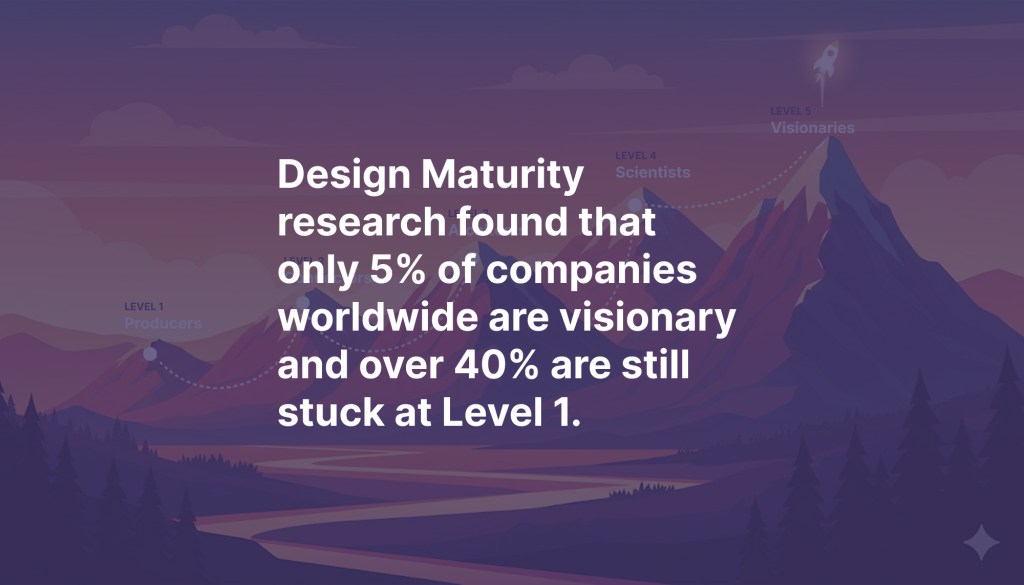
This data proves my point: InVision surveyed over 2,200 companies worldwide and found that over 40% are still stuck at Level 1 – the “make it pretty” stage, where design is basically an afterthought.
Too many leaders – design leaders included – want to champion design, but they’re paralyzed. They don’t have a roadmap. They’re still trying to figure out AI, let alone what real design maturity looks like at scale.
And that’s exactly why I’m writing this. Because I’m sick and tired of watching design get treated like a final coat of paint instead of the strategic engine it should be.
If you agree and want to learn how design can become a strategic driver at scale in any organization, then keep reading. I’ll walk you through what design maturity really means, where most organizations are stuck, and how to actually move the needle in yours.
Because I’ve found that when design maturity is high, the entire company levels up. Not just the design team.
What is Design Maturity?
I’ve spent years watching companies and teams wrestle with it, and here’s the truth: Design Maturity isn’t about how pretty your designs look or how many designers you hire.
To me, Design Maturity comes down to two interconnected pillars:
- The level of Design Thinking knowledge and skill across every employee – not just designers, but PMs, engineers, marketers, and executives.
- How well Design Thinking is integrated into the core ways the organization operates, makes decisions, and builds products.

You can have brilliant designers who live and breathe empathy, iteration, and prototyping, but if design is still siloed and treated like a final coat of paint, maturity stays low. The opposite is just as true: you can have design perfectly embedded in every process, but if the team lacks real depth in Design Thinking, you’re just going through the motions.
I’ve seen companies where both pillars are strong. And something powerful happens.
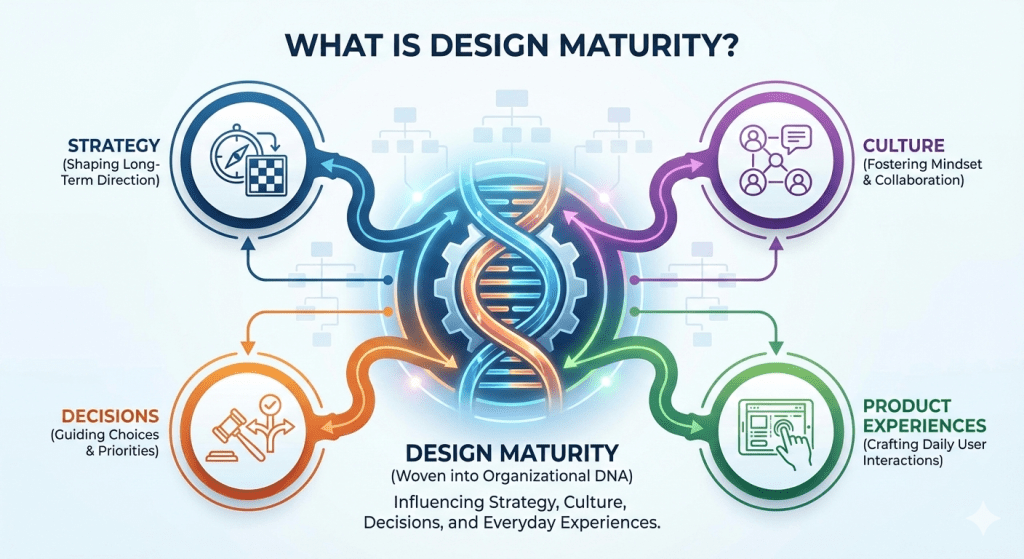
Design gets woven deeply into the DNA of the organization by shaping strategy, culture, decisions, and the products. The organization listens to users relentlessly, solves real problems with curiosity, iterates fearlessly, and treats design as a strategic partner instead of a support function.
Sure, this doesn’t happen overnight. For most large organizations, design maturity is a long, epic journey as you move up each level.
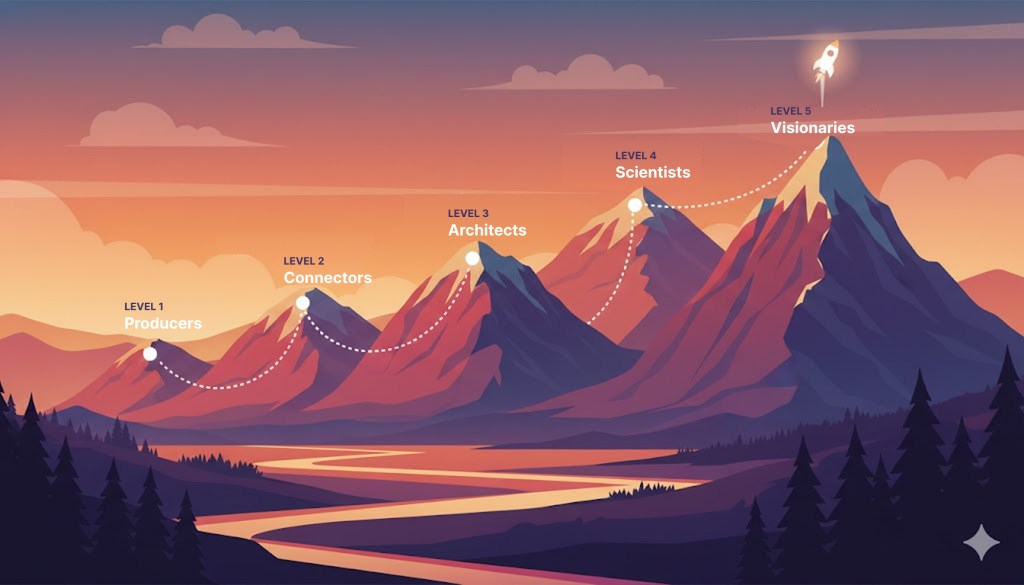
The great news is that design can be applied to all organizations, from small startups, massive corporations, nonprofits, you name it. Everyone moves at their own pace, hits different milestones, sometimes even goes backwards. And that’s okay.
The point isn’t perfection. It’s progress.
So if you’re wondering where your company stands right now, the clearest way is to look at a design maturity model. They’re like maps for the journey ahead. Let’s dive into those next…
Design Maturity Models
Just like any other type of methodology, it’s really helpful to utilize a model to understand how it applies to you and your organization.
With that said, there’s quite a few Design Maturity models that I’ll walk you through.

Review the models and pick the best one that meets your needs. Once you found the right one, I highly recommend you spend some time to fully understand the model and each level of maturity. And then you can use it to assess your organization’s maturity level and then map out the necessary steps to guide your organization in scaling up the Design practice.
Design Maturity Model by InVision
- Overview: A five-level framework that ranges from superficial visual design to strategic, business-driving design
- Who should use it: Tech leaders and product orgs that want a simple but research-backed roadmap for maturing design across product and business functions
- When it works best: When you’re trying to assess where design fits from basic UI work to strategic innovation within a company
From my perspective, I give this model an A+ and highly recommend this Design Maturity model by InVision (even if the company is now defunct) because it’s simple to use and backed by tons of research.
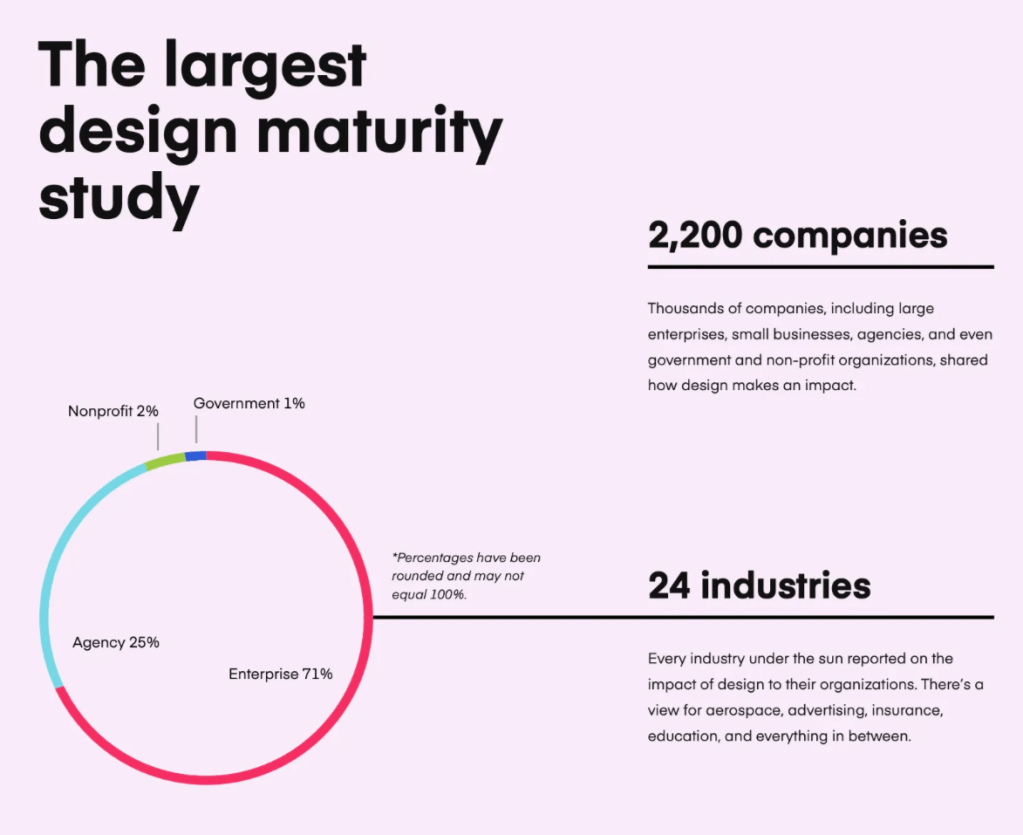
They surveyed over 2,200 companies worldwide and published their findings in The New Design Frontier, a comprehensive report examining design’s impact on business outcomes.
It’s not terribly surprising that they found that 41% of companies surveyed are stuck at Level 1. I think I’m more surprised that the number isn’t actually higher.
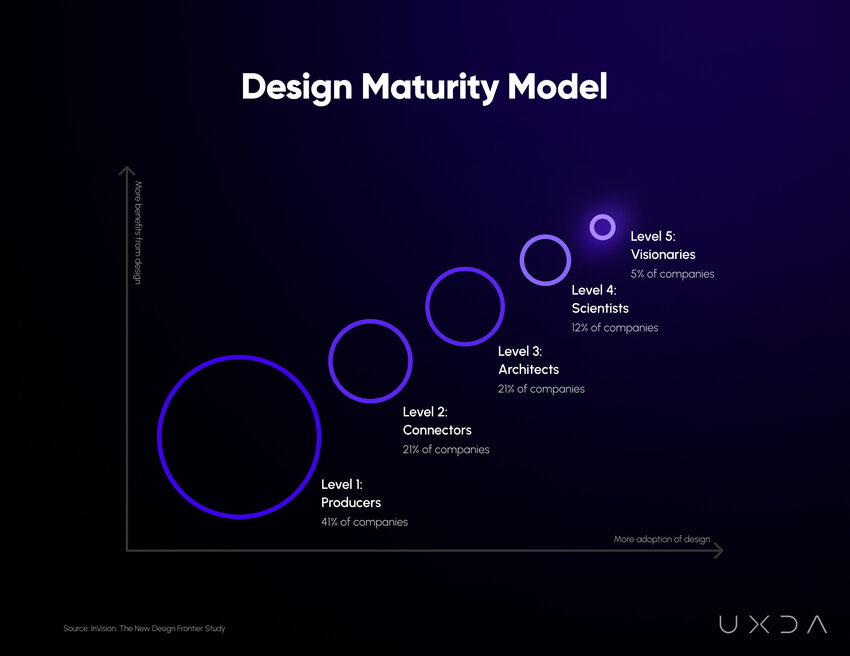
Here’s a quick overview of each stage of the InVision Design Maturity Model:
- Level 1: Producers – Design is purely visual and superficial. It’s seen as “making things look pretty” at the end of a project. Work is siloed, inconsistent, and focused only on the UI.
- Level 2: Connectors – Design becomes a formal process. Teams start collaborating more, using common tools, and incorporating basic user research. There is a shift toward creating consistent user experiences.
- Level 3: Architects – Design is integrated into the product cycle. It moves beyond the design team and becomes a shared responsibility. This level usually features the birth of a Design System to scale efficiency.
- Level 4: Scientists – Design is data-driven and hypothesis-led. Teams use A/B testing, analytics, and sophisticated user research to prove value. Design success is directly linked to business KPIs (like conversion or retention).
- Level 5: Visionaries – Design drives business strategy. It’s used to explore new markets, define the long-term product vision, and shape the company’s DNA. At this level, design is a proven contributor to the bottom line.
Stages of UX Maturity by Nielsen Norman Group
- Overview: The Stages of UX Maturity from Nielsen Norman Group is one of the most well-known Design Maturity models that utilizes a six-stage model that charts the evolution of UX practices from nonexistent to deeply user-driven
- Who should use it: UX and product leaders aiming to evaluate and strengthen user-experience capabilities across processes, tools, culture, and strategy
- When it works best: Best for orgs focusing specifically on UX adoption rather than design broadly, especially where UX practices are inconsistent or nascent
From my perspective, I give the UX Maturity model a B because it’s detailed, UX-centric model that’s excellent for understanding your UX capabilities within your company, but I don’t really recommend it because it’s too narrow for most modern design orgs that encompass both UI and UX.
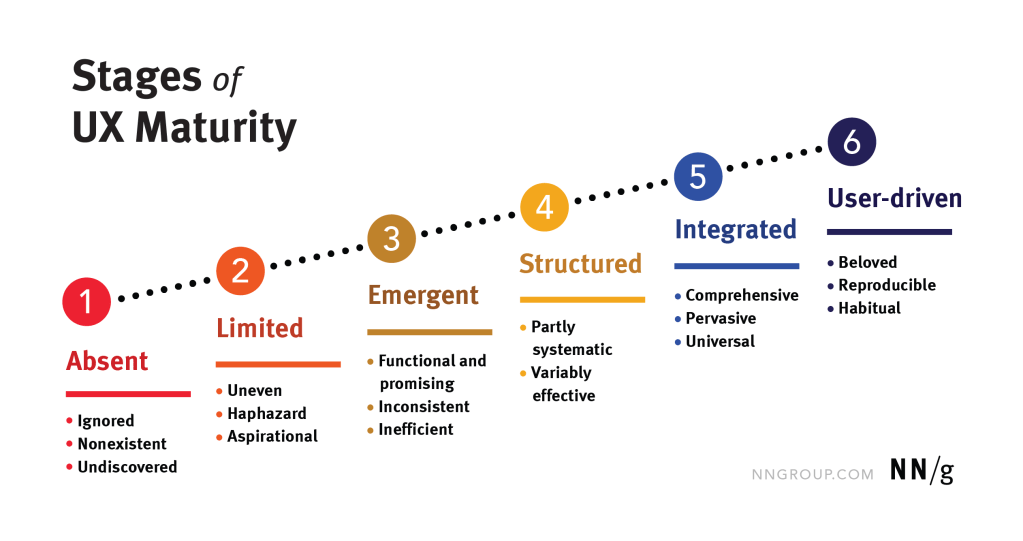
Here’s a quick overview of the 6 stages of UX maturity:
- Absent – UX is ignored or nonexistent.
- Limited – UX work is rare, done haphazardly, and lacking importance.
- Emergent – The UX work is functional and promising but done inconsistently and inefficiently.
- Structured – The organization has semi-systematic UX-related methodology that is widespread, but with varying degrees of effectiveness and efficiency.
- Integrated – UX work is comprehensive, effective, and pervasive.
- User-driven – Dedication to UX at all levels leads to deep insights and exceptional user-centered–design outcomes.
Design Ladder by Danish Design Center
- Overview: The Design Ladder was invented by the Danish Design Center back in 2001 and is a four-rung maturity ladder linking design integration with business value, from invisible to strategic
- Who should use it: Business and product leaders who want to connect design maturity to business value and culture change
- When it works best: Useful when you want a business-focused perspective on design’s role, linking it directly to strategic impact like revenue and competitive advantage
From my perspective, I give this a B grade because it’s particularly persuasive for executives who want to frame Design Maturity as a business driver, however, it’s lighter on tactical steps.
It provides quite a bit of depth and ideas to implement design more in your business, explaining how you can embed each stage in an organization and culture. From a business perspective, The Design Ladder is based on the idea that there is a link between revenue and design.
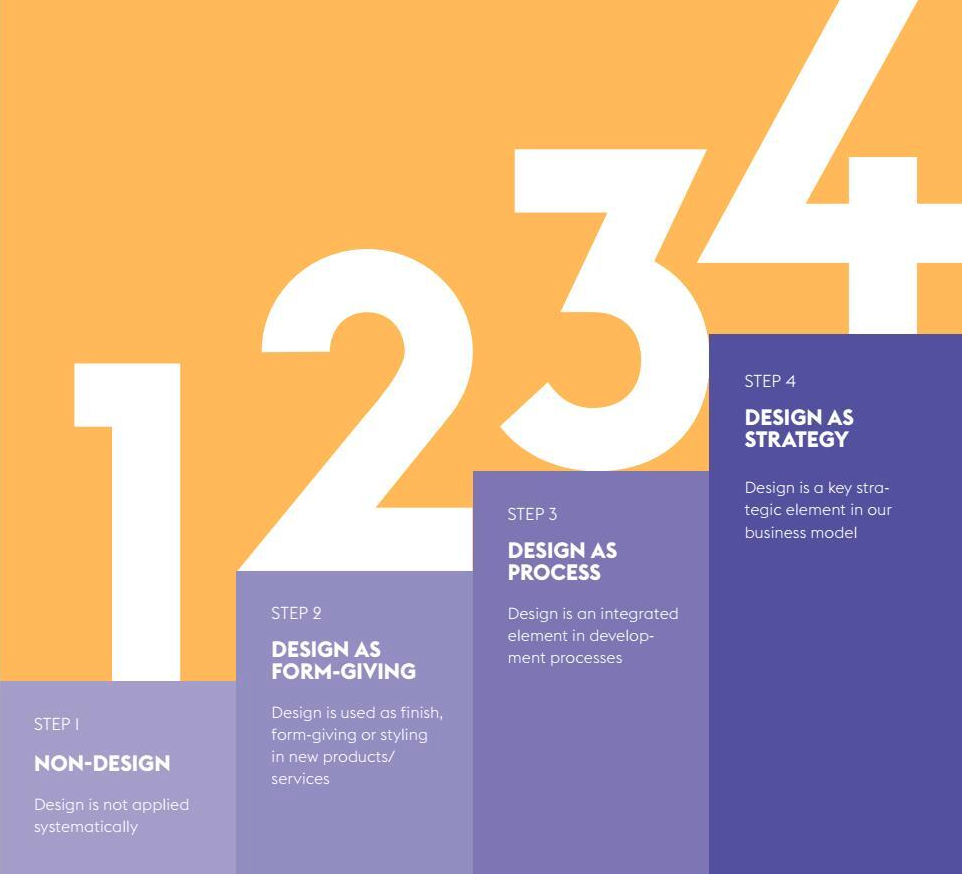
Here’s an overview of the Design Ladder maturity model:
- Rung 1: Non-Design – Design is invisible. Product development or marketing initiatives are undertaken by untrained designers. Things are produced by the ideas of a small number of people. The user or customer perspective does not really play a part in decisions.
- Rung 2: Design as Styling – Design is looked at as the a way of making something look nice at the end of the process. It’s about aesthetic. For example, a product is developed and then given to a product designer to make look nice at the end. Or graphic design is used to simply create a veneer in the positioning of products or services. Little thought is given to the design of the overall experience.
- Rung 3: Design as Process – In this rung, design is not considered as a result but as a way of thinking. Design methods are inbuilt into the early stage of product or service development. Solutions are driven by customer-centric problems and collaboration from multiple teams is employed to develop solutions and communications. The whole process is customer-centric.
- Rung 4: Design as Strategy – Design at this level is embedded in the leadership team. Design is embraced and allowed to play a part in shaping the overall business concept. It is employed to create a vision of the company for the future and then to forge the ways the company is going to get there.
The higher you are on the design ladder the more earnings you will obtain – incidentally this was the conclusion of a research paper based on the Danish Design Ladder published way back in 2003 by Anders Kretzschmar.
Design Value Scorecard by Design Management Institute
- Overview: The Design Maturity Matrix by the Design Management Institute (DMI) is a design value scorecard that helps organizations measure design maturity to align investments with strategy
- Who should use it: Mature organizations seeking a structured diagnostic tool to align design investments with strategic goals and outcomes
- When it works best: When you’re trying to assess not just capability but also the impact of design on business performance and cross-functional collaboration
From my perspective, I give this model an A because it’s robust and data-oriented, making it strong for mature orgs that need to justify design investment, but potentially overwhelming for startups.
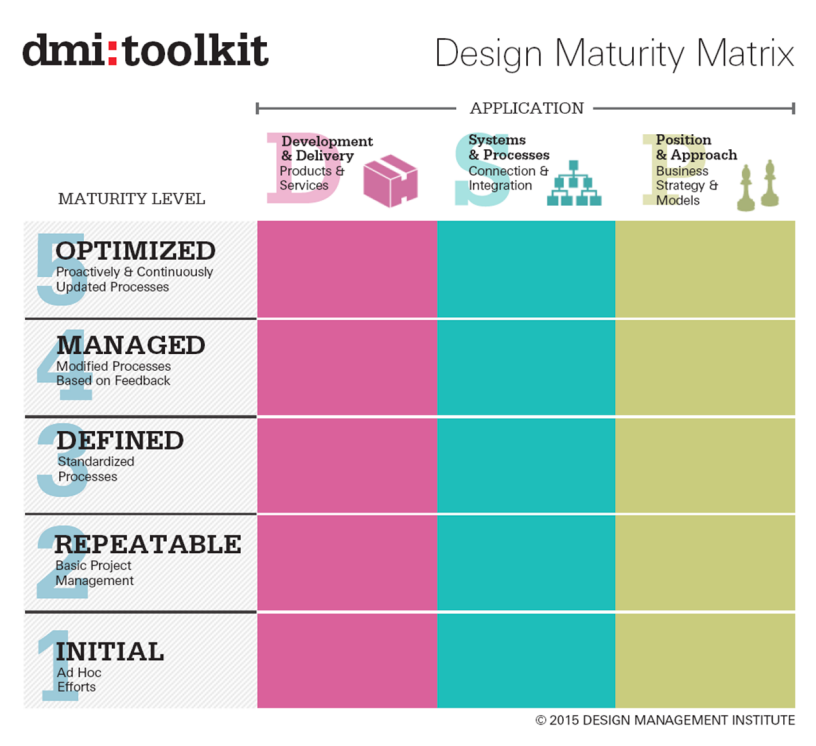
It can be used as a diagnostic and communications tool to:
- Understand the process maturity of the design organization
- Create a common language for strategic discussions with cross functional peers
- Align investments in design with business strategy
Bubble Model
- Overview: The Bubble Model was created by the Competence Center Design and Management (CC D&M) and describes where design sits in an organization, from peripheral to intrinsic
- Who should use it: Orgs wanting to understand how design is positioned and perceived within their organizational structure and strategy
- When it works best: Effective when design is fragmented and you need clarity on whether it lives on the periphery or is intrinsic to your strategy.
From my perspective, I give this model a C because it really helps visualize structural and cultural design challenges, but doesn’t offer as concrete a progression roadmap as some other models.
The Bubble Model helps companies to determine where the design function currently lives – both physically and more importantly strategically – in an organization and how to improve the integration of design. CC D&M realized that where design lives in an organization fundamentally determines how well integrated design is into their overall strategy, culture, and operations.
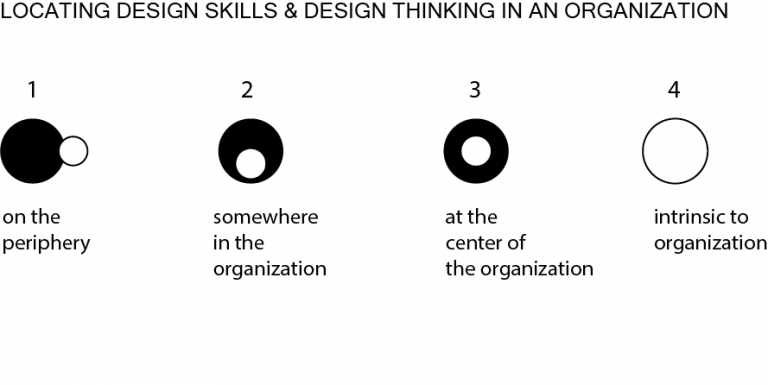
Here’s an overview of the Bubble model:
- Design on the Periphery – The most common location for design in organizations is on the periphery. Design thinking and design methods have no continuous presence in the organization. Design is considered an add-on, limited to traditional design problems such as form, function and communication.
- Design is Somewhere in the Organization – Design thinking and design methods are practiced somewhere in the organization and apply to specific products and services intended for external clients, customers, or market. This may be B2B or B2C.
- Design is at the Center of the Organization – Design thinking and design methods are highly visible and occupy a central position. Design unifies products and services across the organization.
- Design is Intrinsic to the Organization – Design thinking and design methods are applied at the top level of an organization as a means of inquiring into a wide range of organizational problems. The aim of this is to develop integrated solutions that reflect a high degree of coherence between the organization’s internal processes, values, products and services
Benefits of Design Maturity
Organizations suffer when design is only allowed to operate at surface levels. Looking closely, every aspect of an organization suffers: from the people to the processes to the products to the revenue.
I’ll start by diving deeper into the value of design first because that’s what leaders really care about, and then I’ll provide a vision of what successful adoption of design looks like…
The Value of Design
I recently wrote about the value of design using the extraordinary evidence from McKinsey, Harvard, Adobe, Forbes, and the NEA, where they proved design’s transformative power in business as a value driver.
One of the key insights from Harvard was that design-led companies outperform the S&P 500 Index by 228% over 10 years, which emphasizes design as a key differentiator. Which means that there’s a direct correlation between how well design is integrated and widely utilized across the organization.
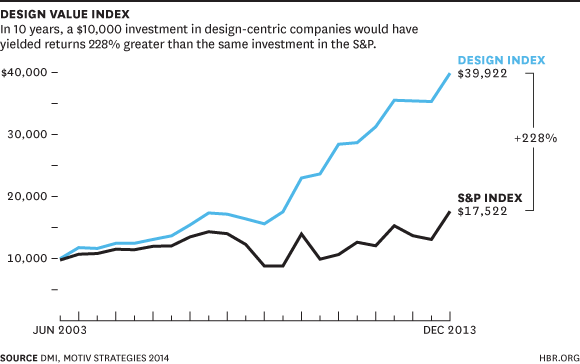
Here are the extraordinary business insights they discovered:
- McKinsey Design Index (MDI): Top-quartile design-led companies excel in analytical leadership, cross-functional talent, continuous iteration, and user experience, correlating with 32% higher revenue growth and 56% higher total returns to shareholders (TRS) over five years across industries like medical technology, consumer goods, and retail banking.
- Harvard Business Review – Design Value Index: Design-driven companies outperform the S&P Index by 228% over 10 years, emphasizing design as a key differentiator in a tech-lowered barrier market where superior products or service alone are insufficient.
- Adobe – Creative Dividend: Creative companies achieve 58% YoY revenue growth of 10% or more (vs. 20% for less creative peers), 150% higher market share, and 3:1 “best places to work” recognition, driven by integrated digital experiences and customer collaboration.
- Forbes – UX Design Impact: Well-designed user interfaces raise conversion rates by up to 200%, with better UX yielding up to 400%; every $1 invested in UX returns $100 (9,900% ROI), prioritizing UX for customer acquisition, satisfaction, and retention.
- National Endowment for the Arts (NEA) Report: Small manufacturers investing in design see 17.5% sales increases; design-integrated firms have 24% higher product innovation probability, 9.1% higher employment growth, 18.7% higher value-added growth, and 10.4% higher productivity growth, enhancing competitiveness in global markets.

These insights prove design is a cornerstone of innovation and profitability. It also highlights the fact that in today’s tech-driven market, superior products alone don’t suffice; you must be design-driven in order to outperform your peers.
What Successful Design Adoption & Integration Looks Like
When design thinking is truly embedded – not just on the periphery or a one-day workshop – it becomes the operating system for how the company thinks, strategizes, decides, and grows. Here’s an expanded view of what that looks like in practice, across all teams (not just creative), products, and strategy:
- Leadership Alignment & Advocacy
Mature design thinking is visibly championed from the top. The C-suite (CEO, CFO, etc.) speaks the language of design thinking, references user insights in key decisions, and protects design time/budget during crises. Without executive buy-in, even the best rituals and processes get deprioritized. - Strategic Thinking
Deep customer and market research is translated into actionable insights that shape the company’s strategic direction. Design thinking isn’t siloed in UX, where it’s used broadly to inform the product roadmap, business model, and even corporate strategy. Leaders ask “What do people need and want?” before “How do we make money?” and the organization follows the signal. - Ideation & Divergent Thinking
Teams openly generate dozens (or hundreds) of possibilities early in every project. There’s no premature killing of ideas. Brainstorming sessions feel safe and energizing, not performative. Wild concepts are encouraged, documented, and treated as fuel rather than threats. Leaders model this by asking “What else?” instead of “Which one?” first. - Convergence
The organization has disciplined rituals for narrowing options—voting, scoring frameworks (e.g., RICE, MoSCoW), user testing, or data signals. Convergence isn’t about compromise; it’s about identifying the strongest signal from the noise. Teams feel good about killing ideas because they know it’s in service of the best path forward. - Visualization
Abstract ideas are quickly made visible through sketches, journey maps, storyboards, low-fi prototypes, and physical models. People don’t debate in slides, they point at shared artifacts. Futures are tested with paper prototypes before code is written. Everyone speaks the same visual language. - Iteration
The organization expects ideas to evolve through critique and testing. “Version 1 is wrong” is the starting assumption, not a failure. Rapid feedback loops (weekly reviews, user tests, dogfooding) are normalized. Teams celebrate learning as much as shipping. Perfectionism is replaced with relentless improvement. - Systems Thinking
Design thinking connects silos. Teams look at experiences holistically using end-to-end journeys, cross-product consistency, emotional impact, and downstream effects. Decisions consider the full ecosystem: users, business, brand, tech, operations. The organization avoids tunnel vision by zooming out regularly.
How Design Leaders Should Utilize Design Maturity to Improve Their Design Practices
Design maturity is about evolving how design thinking is embedded across your company, from ad-hoc practices to a strategic driver. I put together this guide you can leverage for better design thinking, based on frameworks that I listed above. I’ll walk you through it as if I’m guiding a team I’ve led…
Step 1: Select a Design Maturity Model and Deeply Understand It
As a product leader, it doesn’t matter what Design Maturity model you use. But whatever model you choose it’s absolutely critical that you deeply understand the stages and the characteristics that define them. This is essential for leaders and businesses looking to improve their design practices and reap the benefits of a mature design organization.
Step 2: Assess Your Current Maturity Level
Start with a self-audit of your current Design Maturity level. Here’s a few ways:
- Perform an audit – If you’re an expert on Design Maturity, then you can simply perform your own audit using the model you chose in Step 1 for guidance.
- Collect data via survey – You can create your own survey to send out to your teams based on the model you chose in Step 1 to evaluate where design currently stands.
- Utilize a Design Maturity assessment tool – You can utilize a free Design Maturity assessment tool. I recommend the assessment survey from UX-PM, where you can send the link out to everyone in your organization and they can send you their final score along with a screenshot of the final analysis.
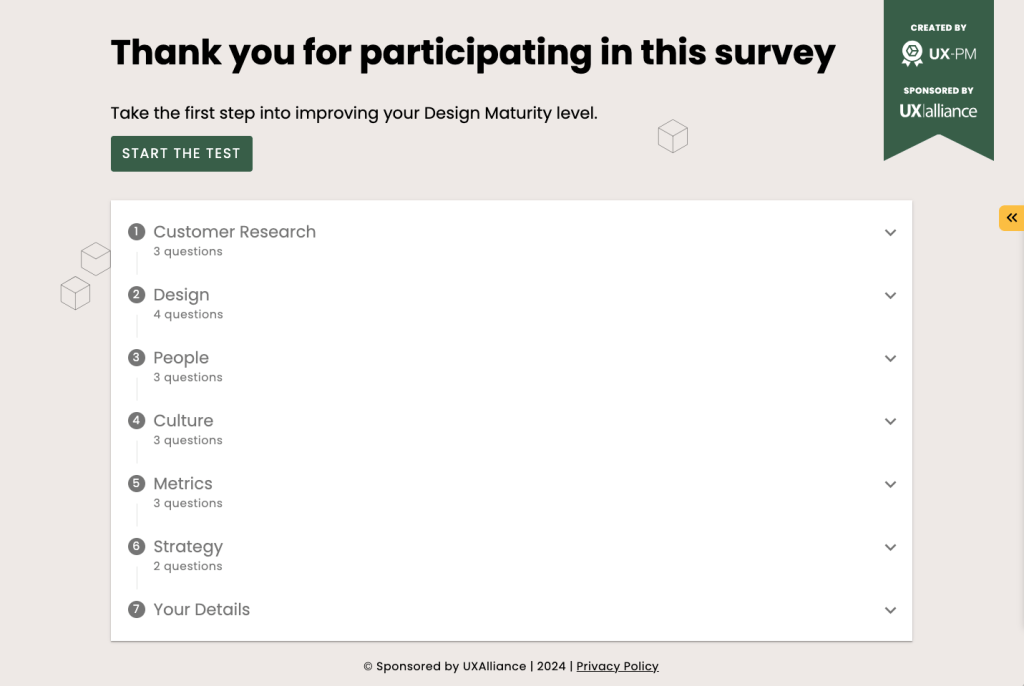
The UX-PM assessment tool will help you get some quick data across the organization in the areas of customer research, design, people, culture, metrics, and strategy.
For example, our score on the Battle.net platform (part of Blizzard/Microsoft) is a 1.6 out of a 5. We were at 2.5 in 2022 but unfortunately we’ve been going backwards the last few years due to our new leadership that doesn’t value design. Like us, you shouldn’t let your initial results discourage you from pushing design forward!

You can review the findings with cross-functional stakeholders to score your maturity honestly. This baseline will reveals gaps, and thus opportunities where you can make improvements.
Step 3: Create a Vision and Plan
Utilize the model you selected in Step 1 along with your assessment in Step 2 to help create a vision for what success looks like and a design maturity roadmap to help you get there. Make sure your plan clearly addresses both:
- Advancing Design Thinking knowledge and skills across the organization through targeted training and education
- Integrating Design Thinking into the core ways your organization operates, decides, and builds products
For example:
- Short term – Train teams on design thinking, workshops, user research, and empathy mapping
- Mid-term – Integrate human-centered design into product cycles
- Long-term – C-suite champions design thinking broadly in the organization

I recommend you define goals, budget (trust me you need a budget!), and align on objectives tied to business outcomes (e.g. Boost CSAT by 15% through better user journeys, etc.).
Once your Design Maturity strategy is done, make sure you review it with leadership. I’ve always found that this is one of the most important aspects of building and scaling design. I recommend including examples (e.g. Airbnb’s maturity shift doubled revenue) to help educate them on design’s value, ROI, etc.
Step 4: Build Foundational Capabilities
Start by training everyone – not just designers – on design thinking basics, starting with the Design Thinking process and workshops.

With this knowledge, start using Design Thinking workshops to help teams collaborate, ideate, and solve complex problems. Focus on divergence/convergence by encouraging wild ideation sessions, then data-driven narrowing.
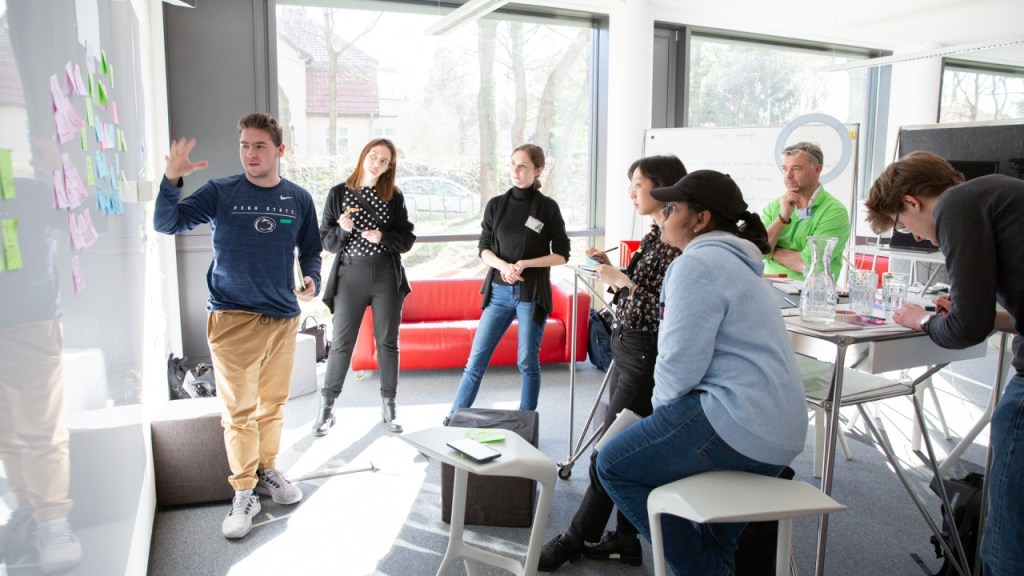
Next, train everyone on Human-Centered Design for creating products and marketing that customers will love. Establish design processes, hire or train Design Thinking SME’s, and institute rituals like weekly reviews or quarterly innovation labs. Invest in tools (Figma, etc.) and hire if needed (e.g., a Design Ops lead).
Step 5: Integrate Design Thinking Organization-Wide
You can truly unlock design’s value by nurturing it in every department. You can do this by training other departments on Design Thinking, while actually embedding a designer to help them learn and grow.
Tie design to strategy by using customer insights for roadmaps. Foster a culture of experimentation and learning, where you celebrate failures as learnings. Track adoption across the org by measuring how often non-design teams use design thinking workshops, tools, etc.

Maturity rarely develops evenly across an organization. But you can accelerate the maturity of design by involving and empowering designers where ambiguity, opportunity and risk are highest. These are the areas where linear planning breaks down, expertise alone stops being enough, and teams need experimentation, creativity and distributed judgement.
I also want to note that incorporating design broadly doesn’t weaken other disciplines, it strengthens them. They help PM and engineering build design literacy without forcing those teams to compensate for an underpowered design function.
Step 6: Measure, Iterate, and Scale
Establish goals, OKRs, and KPIs (e.g., idea-to-launch time, user satisfaction, innovation rate) and embed them in your yearly organizational planning and goals. Review them quarterly to see what’s working and what’s not, and adjust goals based on data and feedback from the teams.

As maturity advances in the organization, begin to scale it from project-level to enterprise-wide. Celebrate wins to build momentum by sharing how a design thinking pivot saved costs. Remember, this isn’t a sprint, it’s a marathon. You should start small, build wins, and watch design thinking transform your org from reactive to visionary.
Conclusion
For a long time, most companies treated design like the “polishing department,” essentially the people you call at the end to make things look pretty. But I’ve realized that true Design Maturity isn’t about avoiding mistakes or making nicer buttons.
It’s a secret weapon and competitive advantage.

It’s what allows us to spot opportunities well before the competition even knows it exists. It gives us the guts to chase big ideas because we’ve actually done the work to understand if they’ll matter.
And if we really want our companies to do more than just survive the AI revolution, we have to stop playing defense! We need our teams to have the maturity to not just deliver a product, but to discover what’s actually worth building.
I’ve lived it long enough to know that when it’s working right, design is the thread that pulls everything together.

It helps us to understand our customers deeply, turning these insights and data into stories people actually care about. To solve complex problems anywhere in the organization. But that only happens when the power of design is understood and included from day one, sitting alongside PMs, engineering, leaders, and stakeholders shaping the path forward instead of just reacting to it.
The future we want to live in isn’t just going to show up at our door. It’s going to be built, brick by brick, by the organizations that have the courage to embrace design in everything they do.