

Everywhere I look, I see headlines about AI.
AI will change how we work.
AI will 10x productivity.
AI will replace entire workflows.
And I honestly believe a lot of that.
But as a design leader, I’ll say the quiet part out loud:
AI is about to push a lot of design organizations backwards in design maturity.
Not because designers suddenly got worse. And not because we lack ambition.
But because AI introduces a level of speed and ambiguity that most organizations simply aren’t built to handle.

And I’m already seeing the cracks.
The Illusion of Progress
Over the past year, I’ve watched teams rush to “use AI” everywhere without redefining anything around it.
No rethinking of process.
No recalibration of quality bars.
No clarity around decision ownership.
Just… raw speed.

Output is skyrocketing. Screens are multiplying. Prototypes are everywhere.
But thinking? That’s nowhere to be found.
I feel like everyone is sprinting as fast as possible in the wrong direction!

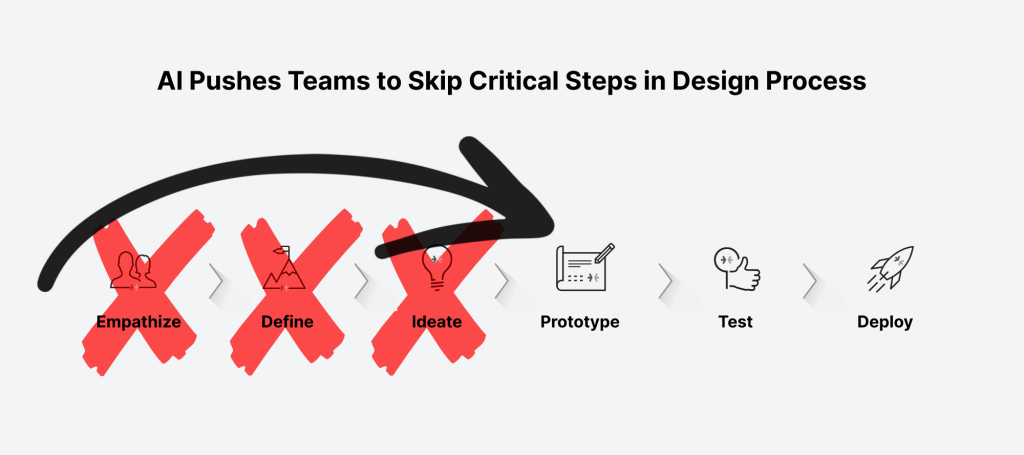
When everything can be generated instantly, the temptation is to skip the slow parts. The uncomfortable parts. The parts that actually require judgment.
- Framing the problem
- Doing the research
- Sitting in ambiguity
- Exploring multiple paths
Those are the muscles that define mature design organizations. And they’re the first muscles to atrophy when speed becomes the only metric that matters.
What is Design Maturity?
For context, Design Maturity is really two interconnected pillars:
- The level of Design Thinking knowledge and skill across every employee – not just designers, but PMs, engineers, marketers, and executives.
- How well Design Thinking is integrated into the core ways the organization operates, makes decisions, and builds products.
You can have brilliant designers who live and breathe empathy, iteration, and prototyping, but if design is still siloed and treated like a final coat of paint, maturity stays low. The opposite is just as true: you can have design perfectly embedded in every process, but if the team lacks real depth in Design Thinking, you’re just going through the motions.

There’s a few different Design Maturity models – I prefer to use InVision’s 5 Levels model because it’s simple and backed by research.
They surveyed over 2,200 companies worldwide and published their findings in The New Design Frontier, a comprehensive report examining design’s impact on business outcomes.
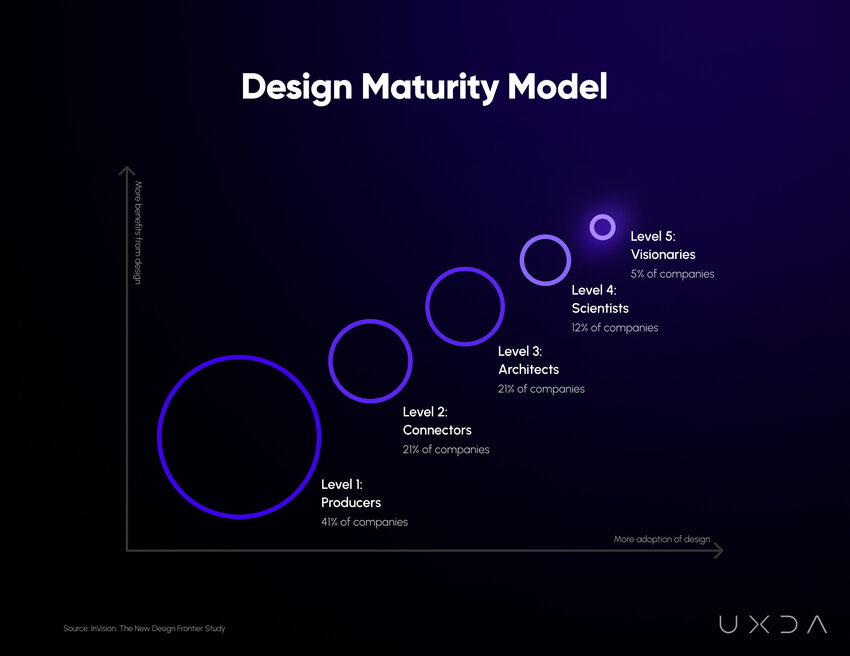
Design maturity encompasses the processes, tools, and methodologies used to create products, services, and experiences that meet customer needs and drive business success. Achieving a high level of design maturity is crucial for companies seeking to differentiate themselves in a competitive market and deliver exceptional user experiences.
The concept of design maturity is built around the idea that organizations progress through various stages as they develop their design capabilities.
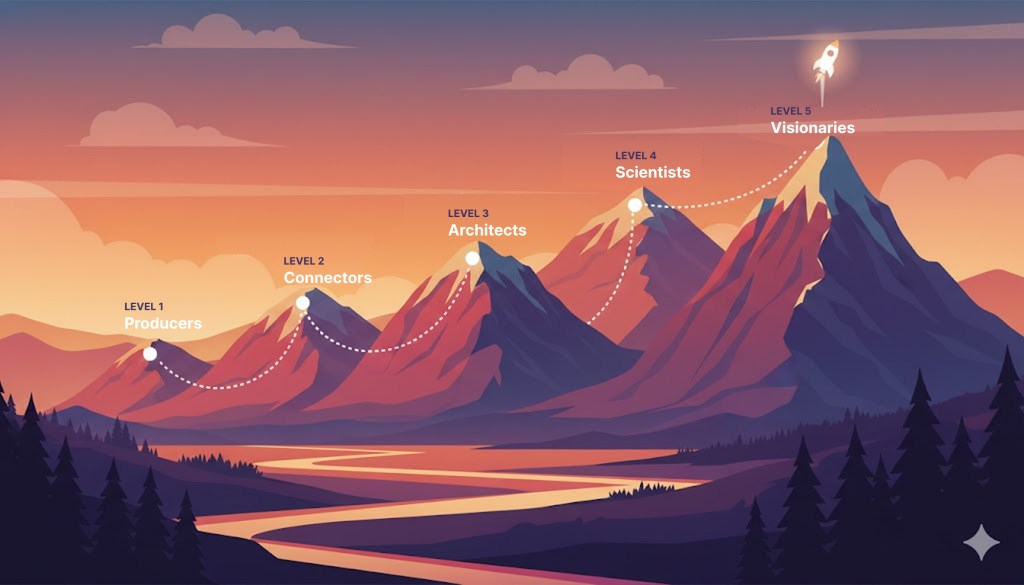
As a design leader, I’ve always built design maturity into my yearly strategies and goals for my Design orgs and teams.
Understanding these stages and the characteristics that define them is essential for businesses looking to improve their design practices and reap the benefits of a mature design organization.
Why Design Maturity Is Going Backwards
Here’s the paradox: AI collapses the time between idea and artifact.
That feels like progress.

But maturity isn’t measured by how fast you produce artifacts. It’s measured by how well you define the problem before you produce anything.
When everything can be generated instantly:
- Junior designers start relying on prompts instead of judgment
- Senior designers get pulled into production firefighting instead of shaping strategy
- Craft becomes optional instead of intentional
And then leadership adds fuel to the fire.
“Do more with less.”
“We don’t need as much headcount now.”
“AI can handle that.”
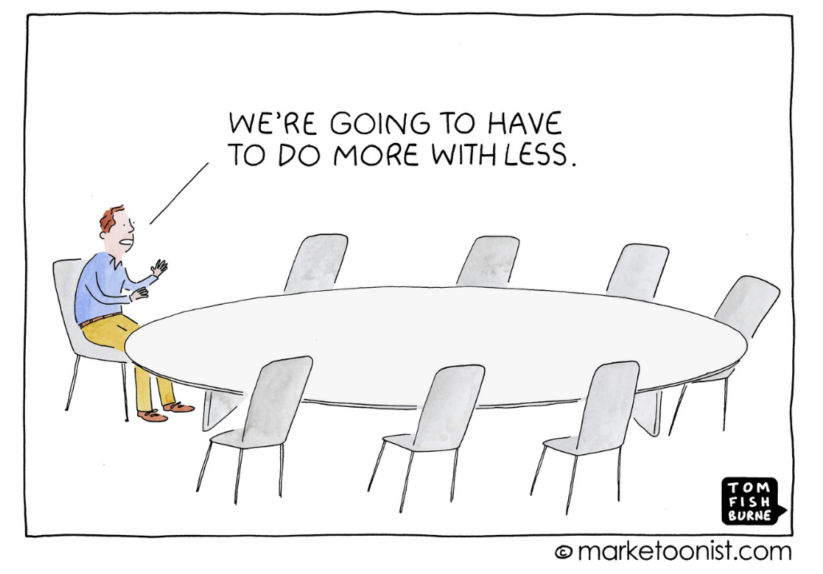
AI shifts from being a multiplier of experience to a substitute for it.
You’ll see design systems get bypassed, then standards start to loosen, and consistency will erode. Eventually design craft becomes optional.
What used to require thoughtful cross-functional collaboration turns into a throughput problem.
And the scary part? It doesn’t feel like failure. It feels like acceleration.
The Real Risk
Every major upgrade in the designer toolkit promised us the world.
Faster prototyping.
No-code builders.
Design systems.
And each one did provide some real efficiencies… but only when paired with stronger thinking. Without that discipline, tools amplify chaos.
AI is the most powerful amplification tool we’ve ever had. It doesn’t just make us faster. It makes us instantly productive.
And instant productivity is intoxicating.
The real risk isn’t that AI will replace designers. It’s that designers will slowly drift back into the role of fast-producing mockup monkeys.
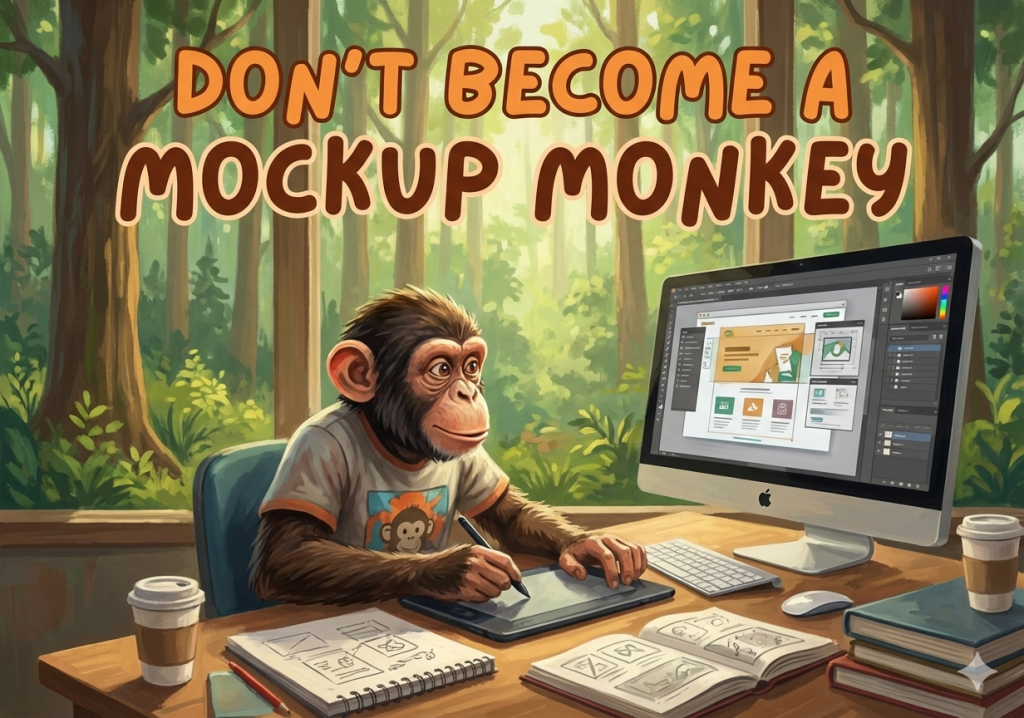
We fought for years to move design upstream. To be strategic partners. To shape product vision instead of polishing it.
And if we aren’t careful, AI will quietly push us downstream again, because when output is cheap, strategy and thoughtfulness looks slow.
And in most organizations, slow gets cut.
How to Avoid Becoming a Mockup Monkey
In order to avoid becoming a mockup monkey, your Design org/team needs to be disciplined enough to:
- Slow down before diving into AI
- Redefine quality standards in an AI-native world
- Protect research time
- Teach judgment, not just prompting
- Use AI to expand exploration — not replace thinking
Maturity will show up in restraint.
It will show up in leaders who say, “Yes, we can generate that in 10 seconds, but should we?”
It will show up in teams that treat AI as a collaborator, not a crutch.
Closing Thoughts as a Design Leader
This year, I’m not measuring success by how much AI my team uses.
I’m measuring it by:
- How clearly we frame problems
- How deeply we understand customers
- How intentionally we craft solutions
- How well design influences the business
AI isn’t the enemy.
But unmanaged speed is.
And if we don’t deliberately evolve our processes, standards, and expectations, design maturity will take a step backwards before it ever moves forward again.
The teams that win won’t be the fastest.
They’ll be the most disciplined.