


I’ve spent years watching companies and teams wrestle with Design Maturity, and here’s the truth: Design Maturity isn’t about how pretty your designs look or how many designers you hire.
To me, Design Maturity comes down to two interconnected pillars:
- The level of Design Thinking knowledge and skill across every employee – not just designers, but PMs, engineers, marketers, and executives.
- How well Design Thinking is integrated into the core ways the organization operates, makes decisions, and builds products.

You can have brilliant designers who live and breathe empathy, iteration, and prototyping, but if design is still siloed and treated like a final coat of paint, maturity stays low. The opposite is just as true: you can have design perfectly embedded in every process, but if the team lacks real depth in Design Thinking, you’re just going through the motions.
I’ve seen companies where both pillars are strong. And something powerful happens.
Design gets woven deeply into the DNA of the organization by shaping strategy, culture, decisions, and the products. The organization listens to users relentlessly, solves real problems with curiosity, iterates fearlessly, and treats design as a strategic partner instead of a support function.
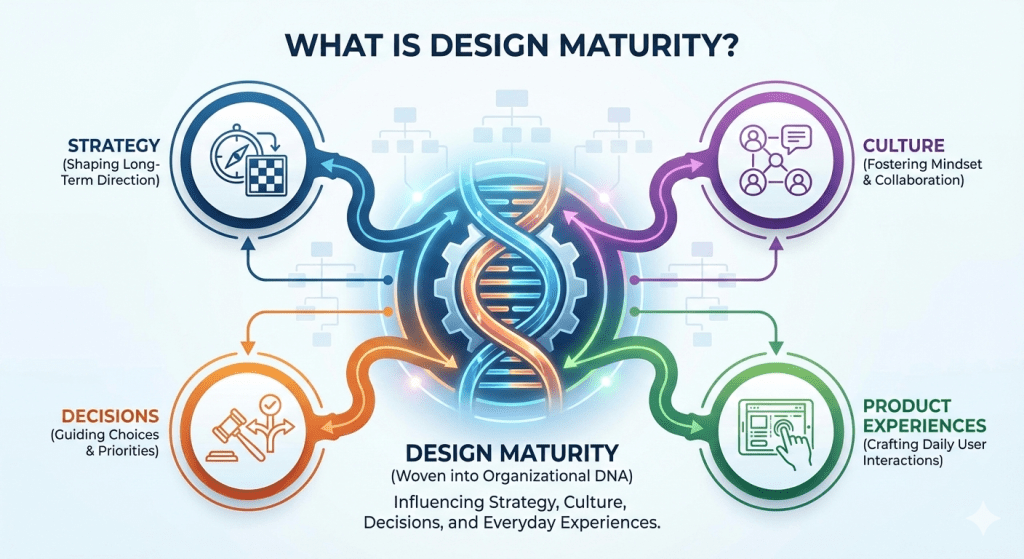
Sure, this doesn’t happen overnight. For most large organizations, design maturity is a long, epic journey as you move up each level.
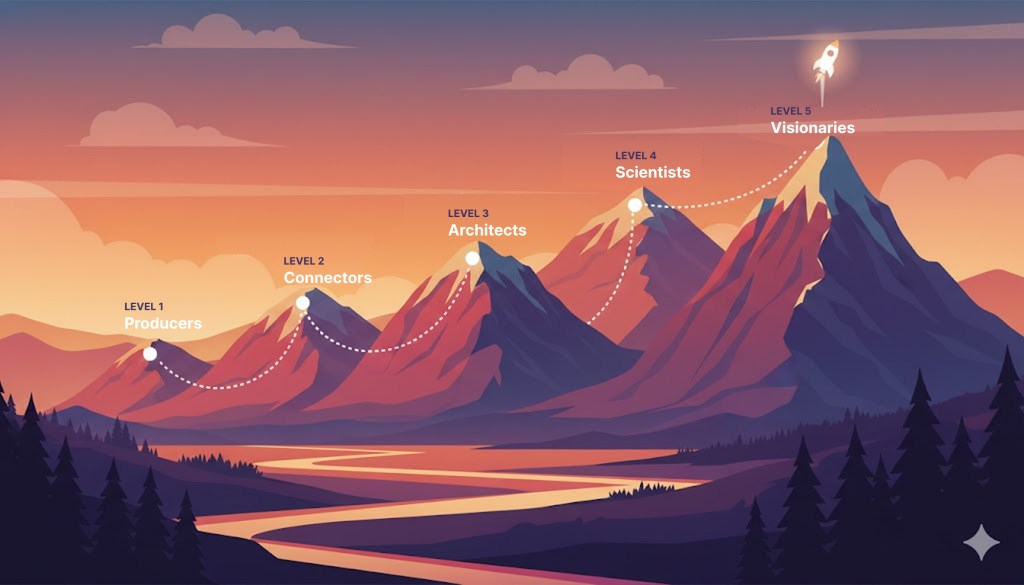
The great news is that design can be applied to all organizations, from small startups, massive corporations, nonprofits, you name it. Everyone moves at their own pace, hits different milestones, sometimes even goes backwards. And that’s okay.
The point isn’t perfection. It’s progress.
So if you’re wondering where your company stands right now, I’ll walk you through a quick way to do an assessment…
The Fastest Way for Design Leaders to Assess Their Design Maturity
As a product or design leader, the fastest way to understand your organization’s Design Maturity is to start with a self-audit. Before you can improve design effectiveness, you need an honest assessment of where your organization stands today.
If you’re already experienced with Design Maturity frameworks, you can conduct your own assessment using one of the models discussed earlier in this article. Some leaders also choose to create custom surveys and interview guides to gather feedback from teams across the organization. However, both approaches require a solid understanding of Design Maturity principles and can be time-consuming to execute.
For most leaders, I recommend starting with a free Design Maturity assessment tool—specifically the Design Maturity Score assessment developed by UX-PM.

The UX-PM assessment evaluates six key areas that influence Design Maturity:
- Customer Research
- Design
- People
- Culture
- Metrics
- Strategy
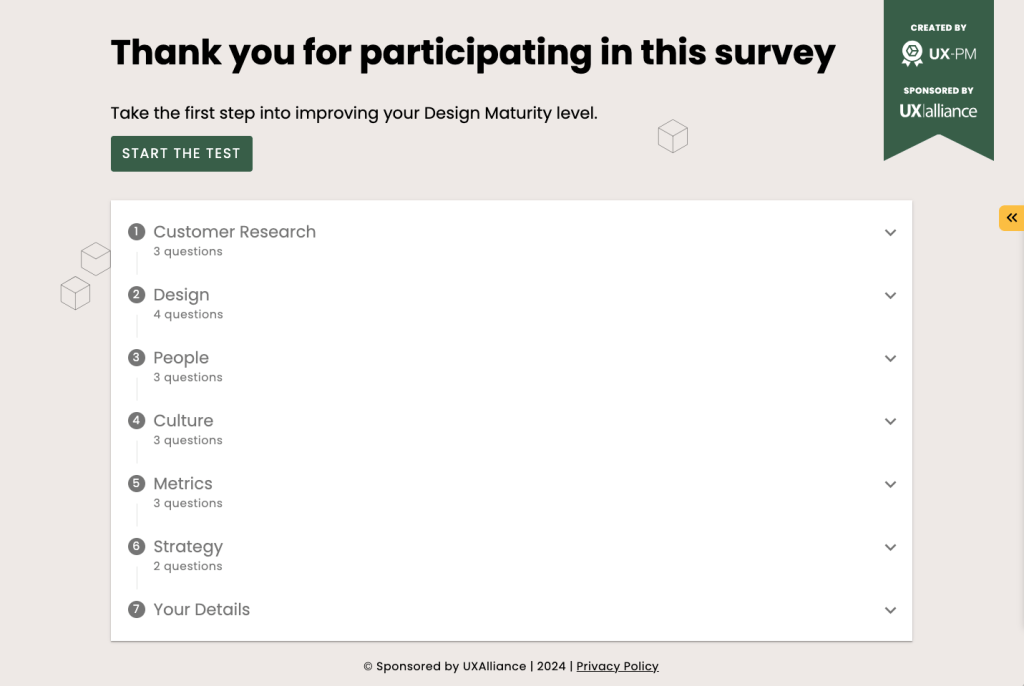
Because the assessment is quick and easy to complete, it can provide valuable directional data in just a few days. More importantly, it creates a common language for discussing design effectiveness across product, engineering, design, and executive leadership teams.
The process for using Design Maturity Score assessment is really simple:
- Distribute the assessment link to stakeholders across your organization, ensuring you share it broadly (beyond design org) with all disciplines, including: Product Managers, Engineers, QA, stakeholders, leadership, etc. Collecting responses from multiple perspectives helps reveal how different teams perceive the role and effectiveness of design within the company.
- Stakeholders will then take the survey, once completed they’ll share both their final score and a screenshot of their results.
- Review and analyze the results.
When I worked at Blizzard (now part of Microsoft), we completed the assessment for the Battle.net platform in 2025 and received an overall score of 1.6 out of 5. This was a drop from our score of 2.5 in 2022 and was clear we were going in the wrong direction. Unfortunately, we had new leadership in place that didn’t value and/or understand design caused our Design Maturity to decline over the past few years.

With that said, don’t let a low score discourage you. While those results were disappointing, they also highlighted exactly where we were and where to focus our efforts moving forward.
The purpose of a Design Maturity assessment isn’t to judge your organization—it’s to establish a baseline. Every insight uncovered represents an opportunity to improve how your teams understand customers, collaborate across functions, and deliver better experiences.
Once you’ve collected the results, review the findings with cross-functional stakeholders and discuss them openly. Challenge assumptions, identify patterns, and score your organization honestly. The gaps you uncover today will become the roadmap for increasing your Design Maturity tomorrow.
Using Your Assessment Insights to Improve Your Design Maturity
Once you’ve completed the assessment, I recommend you follow these steps to develop a plan to improve your Design Maturity broadly in your organization:
Step 1: Create a Vision and Plan
Utilize the model you selected in Step 1 along with your assessment in Step 2 to help create a vision for what success looks like and a design maturity roadmap to help you get there. Make sure your plan clearly addresses both:
- Advancing Design Thinking knowledge and skills across the organization through targeted training and education
- Integrating Design Thinking into the core ways your organization operates, decides, and builds products
For example:
- Short term – Train teams on design thinking, workshops, user research, and empathy mapping
- Mid-term – Integrate human-centered design into product cycles
- Long-term – C-suite champions design thinking broadly in the organization

I recommend you define goals, budget (trust me you need a budget!), and align on objectives tied to business outcomes (e.g. Boost CSAT by 15% through better user journeys, etc.).
Once your Design Maturity strategy is done, make sure you review it with leadership. I’ve always found that this is one of the most important aspects of building and scaling design. I recommend including examples (e.g. Airbnb’s maturity shift doubled revenue) to help educate them on design’s value, ROI, etc.
Step 2: Build Foundational Capabilities
Start by training everyone – not just designers – on design thinking basics, starting with the Design Thinking process and workshops.

With this knowledge, start using Design Thinking workshops to help teams collaborate, ideate, and solve complex problems. Focus on divergence/convergence by encouraging wild ideation sessions, then data-driven narrowing.
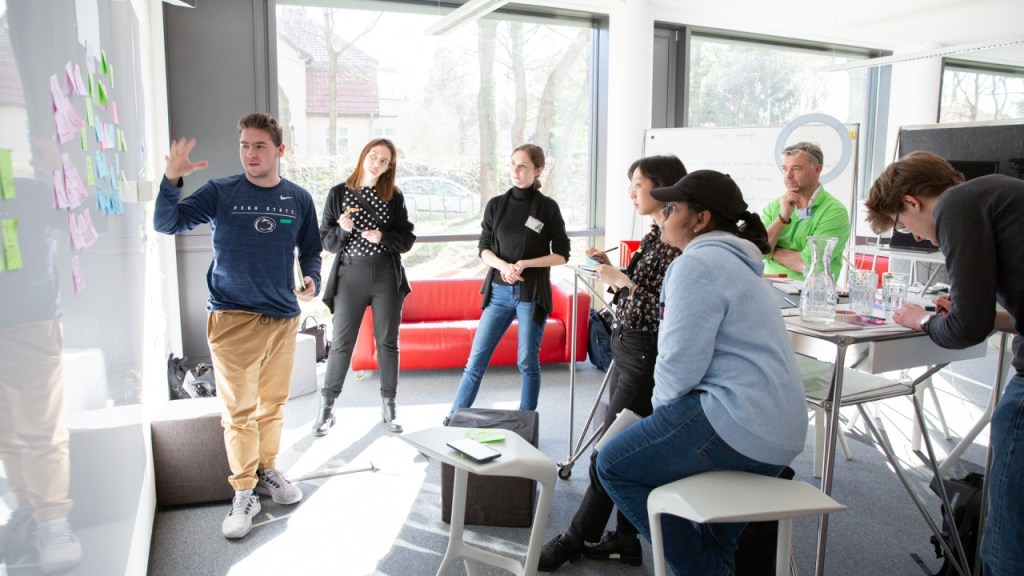
Next, train everyone on Human-Centered Design for creating products and marketing that customers will love. Establish design processes, hire or train Design Thinking SME’s, and institute rituals like weekly reviews or quarterly innovation labs. Invest in tools (Figma, etc.) and hire if needed (e.g., a Design Ops lead).
Step 3: Integrate Design Thinking Organization-Wide
You can truly unlock design’s value by nurturing it in every department. You can do this by training other departments on Design Thinking, while actually embedding a designer to help them learn and grow.
Tie design to strategy by using customer insights for roadmaps. Foster a culture of experimentation and learning, where you celebrate failures as learnings. Track adoption across the org by measuring how often non-design teams use design thinking workshops, tools, etc.

Maturity rarely develops evenly across an organization. But you can accelerate the maturity of design by involving and empowering designers where ambiguity, opportunity and risk are highest. These are the areas where linear planning breaks down, expertise alone stops being enough, and teams need experimentation, creativity and distributed judgement.
I also want to note that incorporating design broadly doesn’t weaken other disciplines, it strengthens them. They help PM and engineering build design literacy without forcing those teams to compensate for an underpowered design function.
Step 4: Measure, Iterate, and Scale
Establish goals, OKRs, and KPIs (e.g., idea-to-launch time, user satisfaction, innovation rate) and embed them in your yearly organizational planning and goals. Review them quarterly to see what’s working and what’s not, and adjust goals based on data and feedback from the teams.

As maturity advances in the organization, begin to scale it from project-level to enterprise-wide. Celebrate wins to build momentum by sharing how a design thinking pivot saved costs. Remember, this isn’t a sprint, it’s a marathon. You should start small, build wins, and watch design thinking transform your org from reactive to visionary.
Conclusion
For a long time, most companies treated design like the “polishing department,” essentially the people you call at the end to make things look pretty. But I’ve realized that true Design Maturity isn’t about avoiding mistakes or making nicer buttons.
It’s a secret weapon and competitive advantage.

It’s what allows us to spot opportunities well before the competition even knows it exists. It gives us the guts to chase big ideas because we’ve actually done the work to understand if they’ll matter.
And if we really want our companies to do more than just survive the AI revolution, we have to stop playing defense! We need our teams to have the maturity to not just deliver a product, but to discover what’s actually worth building.
I’ve lived it long enough to know that when it’s working right, design is the thread that pulls everything together.

It helps us to understand our customers deeply, turning these insights and data into stories people actually care about. To solve complex problems anywhere in the organization. But that only happens when the power of design is understood and included from day one, sitting alongside PMs, engineering, leaders, and stakeholders shaping the path forward instead of just reacting to it.
The future we want to live in isn’t just going to show up at our door. It’s going to be built, brick by brick, by the organizations that have the courage to embrace design in everything they do.